Can AI agents build
AR and VR apps?
Yes, if the agent has live XR APIs, validation, and a renderer it can run. The ReactVision MCP server gives Claude, Cursor, Codex, and Windsurf the real component catalogue, then lets the agent validate and test scenes, including in a recorded room. A free ReactVision account is enough to authenticate.
Agent-first, not docs pasted into a prompt
Most XR tooling assumes a human in a visual editor, so agents are left guessing from stale training data. ReactVision treats the agent as a first-class builder: the MCP server hands it the same live APIs, component schemas, and infrastructure a human developer uses, plus the tools to check its own work.
What the agent knows
The full ViroReact component catalogue with prop schemas and event handlers, working scene examples, current release notes, and the live platform matrix across iOS, Android, Meta Quest, and visionOS.
What the agent can do
Validate scenes against the real APIs, execute them in a real renderer and read back the frames, diagnose errors and crash logs, check 3D models against performance budgets, diff renders, and convert scenes between the Editor and TSX.
The closed loop: build, validate, test
Writing XR code is the easy part. Knowing whether it renders is the hard part, and it is the part agents normally cannot do. These three steps all run through the MCP server.
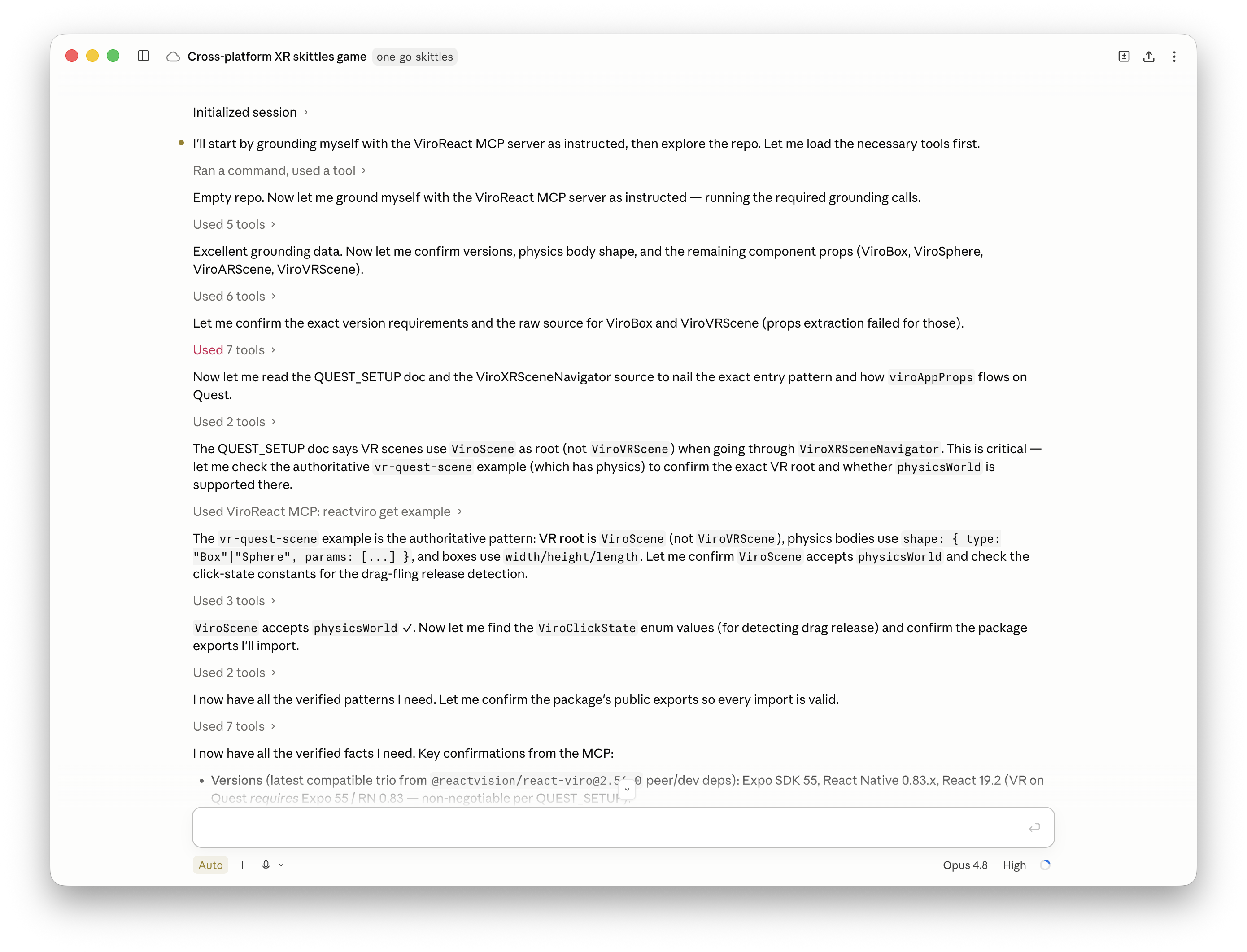
Build
The agent writes ViroReact against the current component catalogue, prop schemas, real scene examples, and the live platform matrix, so it knows what runs where before it commits to an approach.
Validate
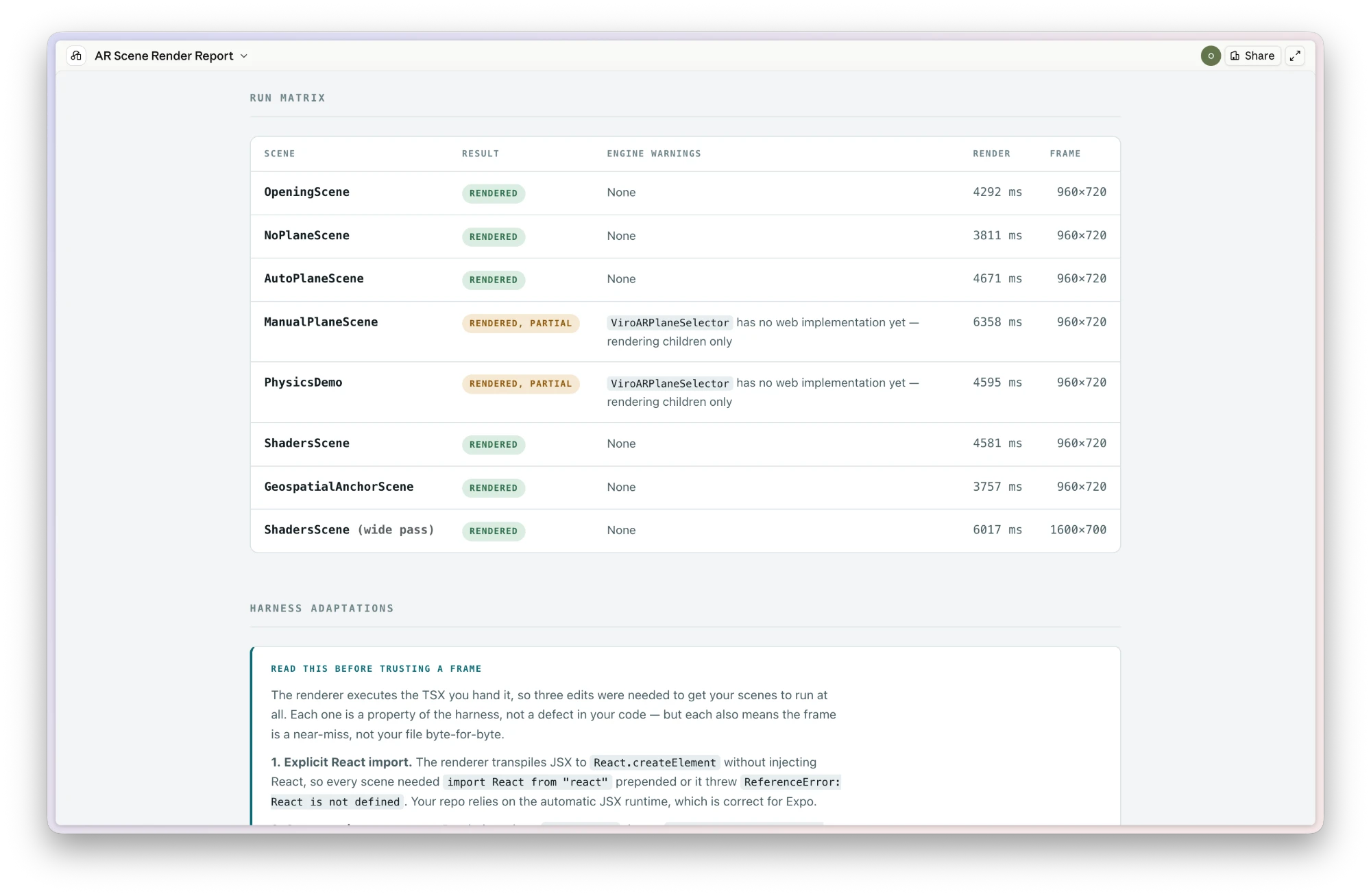
Structural scene checks catch a misspelled prop or a component that does not exist immediately. Performance budget checks flag 3D models too heavy for the target headset, and crash logs come back explained.
Test
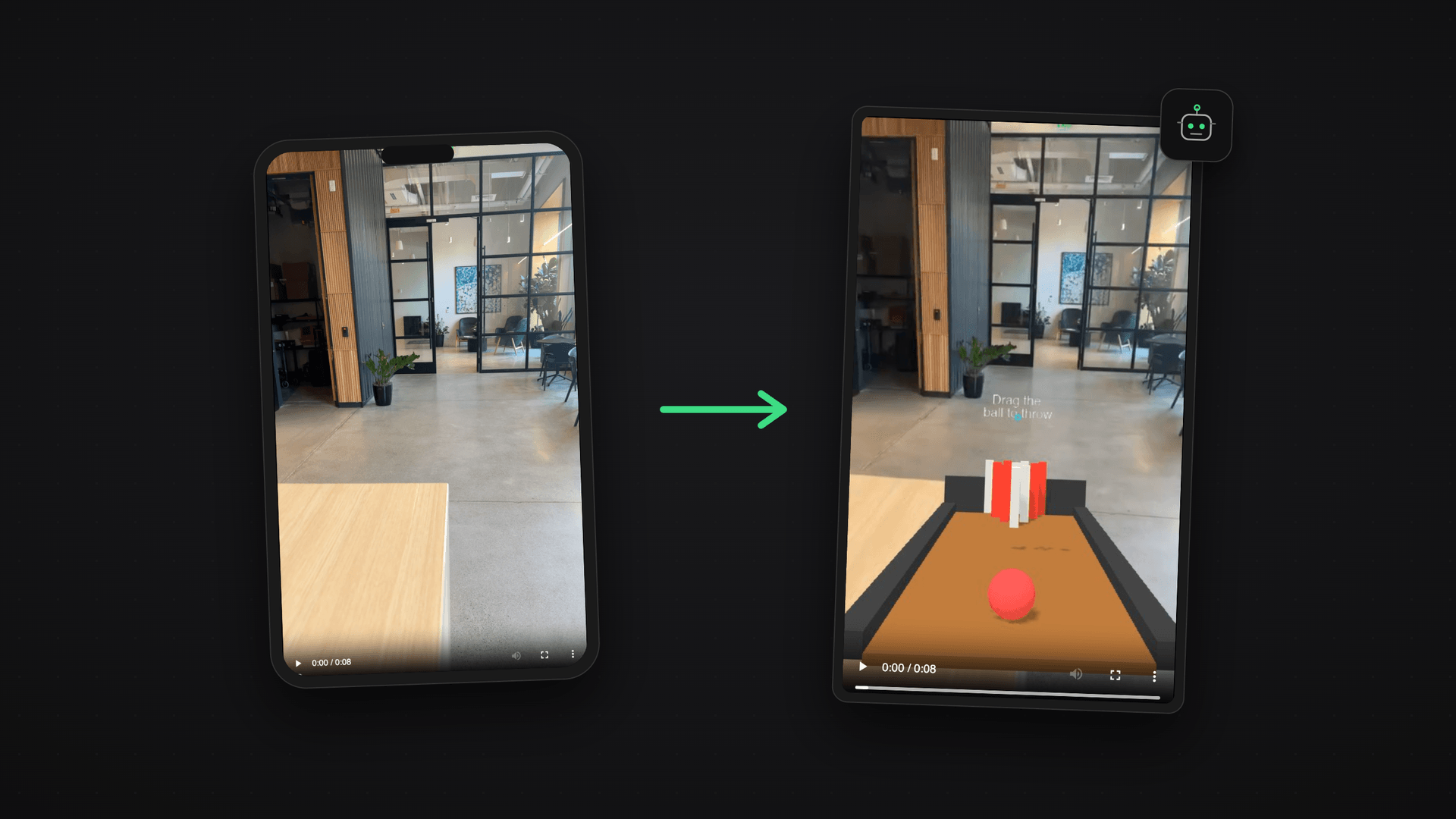
The agent runs the scene in a real renderer and gets the frames back: it taps objects, waits for animations, and compares two renders to see what changed. Record a room once and it can test in that space.
Two agent surfaces, one stack
There are two ways to put an AI agent to work on XR here. Both build against the same renderer, the same ReactVision Spatial infrastructure, and the same scene format.
MCP server, in your IDE or terminal
For engineering teams. Your own coding agent works inside your repo with full ViroReact context and validation tools. Add the server URL, authenticate with a free ReactVision account, and keep your existing prompts and review habits.
Editor agent, in the browser
For designers and mixed teams. Describe the experience and the agent builds scenes, generates and places 3D assets, and wires up physics, animation, and triggers inside the ReactVision Editor, with drag-and-drop editing alongside.
What each part of ReactVision does
ViroReact
The open-source native XR renderer. One TypeScript API mapped onto ARKit, ARCore, and OpenXR. MIT licensed, free forever.
ReactVision Spatial
Managed spatial infrastructure: Cloud and Geospatial Anchors, Co-Location, asset hosting, and environment rendering, accessed with an rvApiKey and rvProjectId.
Editor
The browser-based visual editor and CMS for XR scenes, with a built-in AI agent. Free to sign up.
MCP
How coding agents use the stack: live ViroReact knowledge plus tools to validate, run, and test scenes.
Proof it ships
npm installs of ViroReact per month
npm installs in 2025
iOS, Android, Meta Quest, Apple Vision Pro, and the web, from one codebase
Shipped on ViroReact: Looking Glass (geospatial AR heritage storytelling), Pikd (brand AR for Red Bull and Burger King), InkStory (AR image recognition, built solo). The ReactVision MCP server is listed in the Claude Connectors Directory.
Common questions
Can AI agents build AR and VR apps?
Why is an MCP server better than pasting docs into the chat?
Which coding agents work with the ReactVision MCP server?
What does it cost to connect an agent?
Should I use the Editor agent or the MCP server?
Can the agent actually see whether its scene renders?
Want a worked example? Read how a geospatial AR app was built with Claude Code and ViroReact.
Related comparisons and guides
- Unity alternative for AR and VR →
- Unreal Engine alternative for AR and VR apps →
- Niantic Lightship alternative →
- 8th Wall alternative →
- Open-source Unity and Unreal alternative →
- Best AR/VR/XR tool for React Native →
- Geospatial AR without Niantic →
- One codebase for AR on phones and VR on Quest →
- XR CMS: update content without an app release →
- React Native AR guide →
Put your agent to work on XR
Add the ReactVision MCP server to the coding agent you already use, authenticate with a free ReactVision account, and tell it what to build.