Meta Quest Lands, Studio Scenes Drop In: What’s New in ViroReact 2.55.0
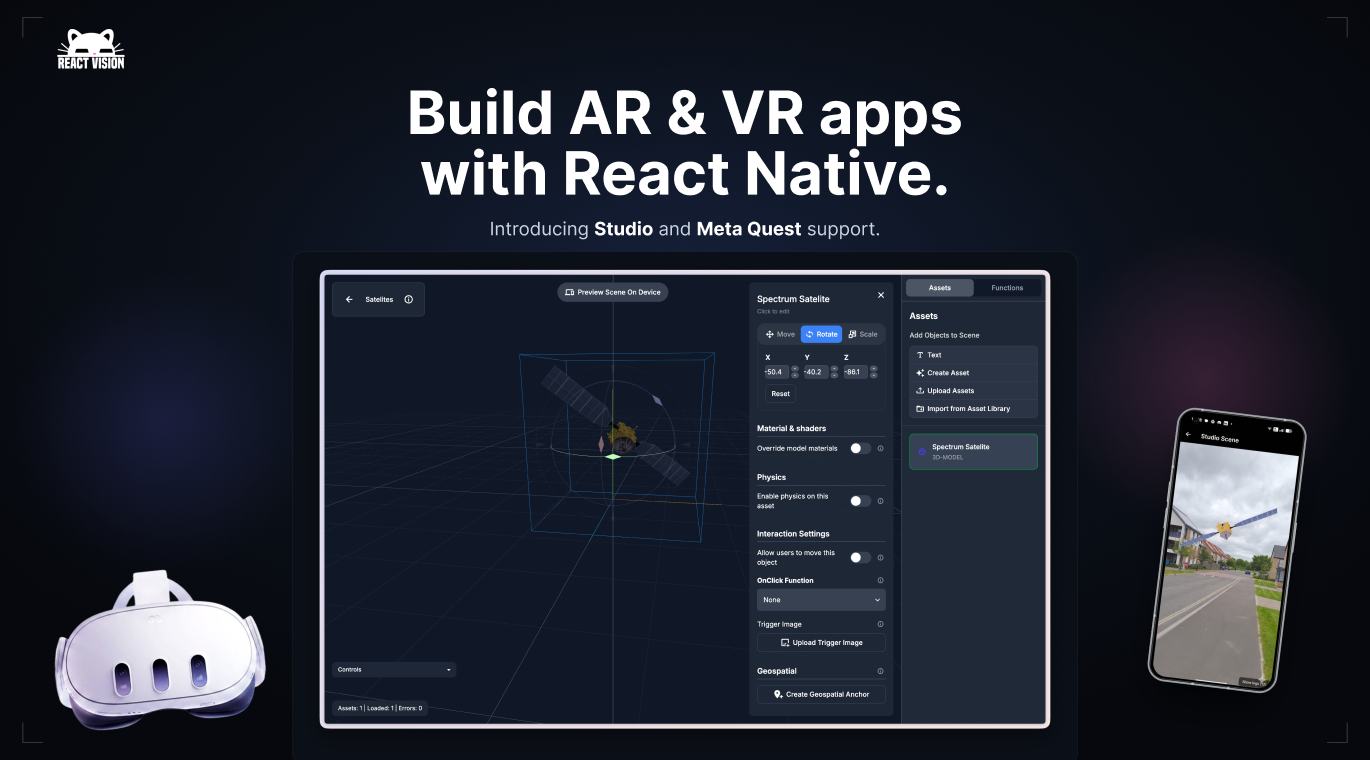
ViroReact 2.55.0 is out today. This is a big release for us. With 2.55.0, ViroReact is truly cross-platform. The same React Native codebase you use to ship AR on iPhone and Android can now ship as a native VR experience on Meta Quest. That’s been the goal from day one, and 2.55.0 is the release where it lands.
Cross-platform XR with ViroXRSceneNavigator
The headline change is a new navigation component, ViroXRSceneNavigator. Drop it into your app, and ViroReact figures out whether to mount an AR scene on phones or a VR scene on a headset. One component, one codebase, every device.
For everyone already shipping a ViroReact app, this is mostly a one-line migration. Replace ViroARSceneNavigator with ViroXRSceneNavigator and your existing scenes keep working, but now your app can also run on Meta Quest. No engine swap, no native rewrites, no separate VR codebase.
If you want to go further and ship a standalone VR app, ViroVRSceneNavigator is also new in this release. It runs on Meta Quest 3, Quest Pro, Quest 2 and Quest 1, and the full ViroReact rendering pipeline comes with it: physics, PBR lighting, real-time shadows, custom shaders, animations, all of it. Nothing needs rewriting. What worked in AR works in VR.
Studio creations come to life inside your apps
The other big thing in 2.55.0 is StudioSceneNavigator. Drop it into your app and ViroReact does the rest. If you've set an opening scene in Studio, you don't need to pass anything else:
import { StudioSceneNavigator } from "@reactvision/react-viro";<StudioSceneNavigator />Want to open a specific scene? Pass its UUID and ViroReact has you covered:
<StudioSceneNavigator sceneId="abc-123-uuid" />For us, this finally closes the loop between Studio (the no-code XR editor we’ve been building) and Viro. You can now design a scene in Studio and bring it to life inside a real ViroReact app, with one component.
And because StudioSceneNavigator is built on top of ViroXRSceneNavigator, every Studio creation is AR and VR compatible from day one. The same scene you build in the browser runs in your AR app on iPhone, and your VR app on Meta Quest. That wasn't possible yesterday.
Please Note: you will need a Studio account, including an API key and project id in order to use this. Full setup details can be found in our docs and you can create a Studio account for free here.
What this unlocks
2.55.0 is the release where the ReactVision pitch becomes real. Write your app once in React Native, design your scenes in Studio, ship to mobile AR and native VR from the same codebase.
And this is just the start. visionOS and Android XR are next on the roadmap, with more platforms after that. The whole point of building ViroReact this way is that a new platform shouldn’t mean a new codebase, it should mean a new target.
What else shipped
A few smaller pieces alongside the headlines:
- useAnySourceHover and useAnySourcePressed: two hooks for handling multi-pointer input in VR, so a button doesn’t need to know which hand or controller is hovering it.
- isQuest and hasOpenXRSupport: runtime exports for branching in your own code.
- Three stability fixes: 16 KB .so page alignment for the new Android 2025 ABI, an Android image-marker child-pinning regression (#465), and continued portal-render hardening on iOS (#452).
The full technical detail (the dual-Activity Quest architecture, the OpenXR backend internals, the new Studio scene API surface) is all in the release notes on GitHub.
Compatibility
No breaking changes. Existing apps upgrade with no code changes; Meta Quest support is opt-in via the Expo plugin. React Native 0.83, Expo 54 and 55, Android Gradle Plugin 8.7+ for the new 16 KB-aligned APKs.
Try it
npm install @reactvision/react-viro@2.55.0The fastest way to see all of this together is the ViroReact + Expo Starter Kit, and we’ll be updating it with a Quest demo scene shortly. If you hit anything weird, open an issue on GitHub or come find us in Discord.
A note of thanks
I want to end with something that isn’t about the release.
The team at ReactVision are the best people I’ve ever worked with. Everyone here is working relentlessly hard to build this into the platform we know it can be, and we won’t stop until we get there. 2.55.0 is on them, and I’m proud of what they’ve shipped.
To every developer who keeps building with ViroReact, and trusts the ReactVision Platform to power their AR apps: thank you. We don’t take that trust lightly, and we work for it every single day.
And to the new developers about to discover ViroReact and Studio together for the first time, now that this integration is live: welcome. We’re looking forward to seeing what XR development feels like when the tools are finally on your side.