Satellite Assembly: AR and VR Training Built with ViroReact
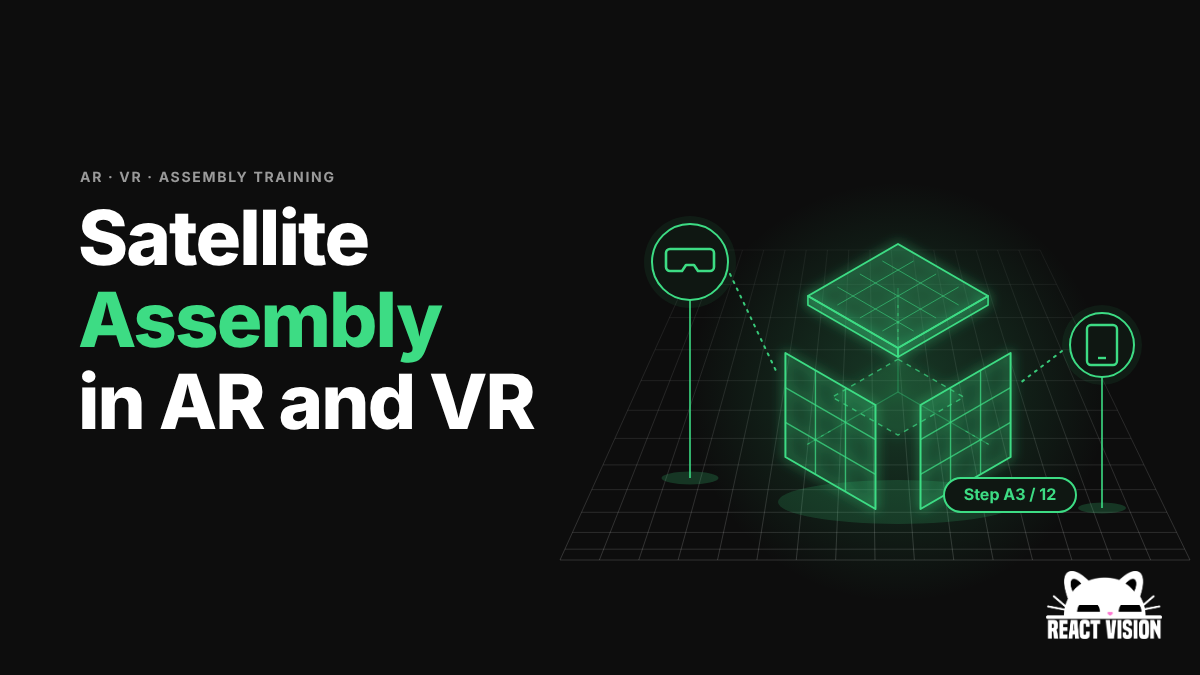
Assembly training is one of the clearest wins for XR in industry. Instead of flicking between a manual and a workbench, a trainee sees exactly where each part goes, in place, step by step. To put ReactVision through its paces on that kind of job, we built Satellite Assembly: an AR and VR assembly training app that runs on iPad, Android tablets and Meta Quest headsets from a single ViroReact codebase.
Here's what it does, how we built it in two days, and how you can try it.
Why we build our own prototypes
We're always expanding what you can do across the ReactVision stack, from the ViroReact renderer to ReactVision Spatial and our MCP server for AI coding agents. Our goal is simple: to be the best stack for you, and your agents, to build XR apps with.
A big part of that is dogfooding. We regularly build real apps on our own tools so we hit the same issues, gaps and hurdles our community does. Then we fix them. It's the most reliable way we know to make sure each release actually makes building with ReactVision better.
What is Satellite Assembly?
Satellite Assembly is a training and guided assembly app for a real satellite design: the 1U CubeSat, a standard 10 cm cube used for small space missions. The app runs on:
- Tablets: iPadOS and Android
- Headsets: Meta Quest 3, Quest 3S and Quest Pro
The app covers two jobs. First, it teaches someone how to assemble the satellite. Then it guides them through building the real thing.
AR assembly training in two modes
Satellite Assembly offers two levels of training, so trainees can build confidence before working on their own.
- Easy mode: You start with an exploded view of the satellite, then watch it come together one step at a time.
- Hard mode: All the parts are laid out in front of you and you assemble the satellite yourself, with instructions for each step.
To mirror a proper training process, the app captures a photo as evidence each time a step is completed. At the end of the session, those photos are collated into a PDF report you can export and keep as a training record, with a timestamp and photo for each fitted step.
An offline backend for closed networks
For many teams, assembly and training software is business critical, and connecting it to the outside world simply isn't an option. So we built a lightweight backend, based on ReactVision Spatial fundamentals, that runs entirely inside a closed network.
You run the server locally, and any device on the same network can connect to it. From there, the app can:
- Upload logs to the local server
- Download new content, such as updated training data, new designs and fresh guided assembly instructions
The result is an app that stays up to date without ever touching the public internet. The server is optional: without it, the app uses its built-in procedure and keeps evidence on the device.
Guided assembly with on-device object detection (and a caveat)
The vision for guided assembly is that the app understands what's in front of you. Using on-device object detection, it would recognise the start of each step, show you what to do, then detect when you've finished and move you on to the next one. ViroReact supports running object detection models on-device, so this is entirely achievable.
The caveat: we don't have a 1U CubeSat to hand. Without the real parts, we couldn't train a model to recognise them. Instead, the demo recognises everyday desk objects, such as a monitor or laptop, to trigger the first step. From there it walks you through the assembly guides, and you can skip ahead to the finished satellite.
With the physical parts, full step-by-step recognition would be very achievable. Even in its current form, it shows how much you can do with ViroReact for relatively little effort.
One codebase, two development days
Because Satellite Assembly is built on ViroReact, one codebase runs on every platform it supports. This version targets tablets and headsets, but adding phone support would take us minutes, not weeks.
We built the app with Claude Code connected to the ReactVision MCP server. The whole thing took two development days in total, worked on in the background over a few days.
The MCP's real-room testing tools made a big difference. Our agent could test its own work in realistic environments, so by the time we tested the app ourselves, we knew it worked.
Try Satellite Assembly
Satellite Assembly is available now from our Quest Demos page. The APK works on both Meta Quest headsets and Android devices.
We're working on bringing the app to the App Store for iPad and Apple Vision Pro users too. It'll be there as soon as Apple's review process allows.
Want to see more? Book a demo with our team for a full walkthrough of how we built it, how it's set up, and a hands-on look at the closed-network integration. Get in touch and we'll show you what's possible when you build with ReactVision.
Get the ReactVision newsletter
Product announcements, including ViroReact, ReactVision Spatial, Editor and MCP updates, direct to your inbox. No spam, and you can unsubscribe at any time.